 Deutsch
 English GB
 Italiano



Search in blog
Build hanging steps yourself
Build slope steps yourself – practical tips and ideas for your garden
If you are thinking about building slope steps yourself and incorporating them into your garden, you can benefit from the wide range of different components in our collection. Whether you choose our high-quality slope steps, stepping plates or railings, the many design options allow you to create steps in your garden to suit your ideas and let your creativity run free. We’ll show you some handy tips for building slope steps yourself, enhancing your garden and making it safer to walk around.

Build slope steps yourself – planning to suit your garden style
When creating slope steps, you can take a wide range of garden styles into account to create a harmonious overall look that reflects your individual preferences. If you want to build slope steps yourself and make steep sections of your garden accessible, you can choose from a variety of designs.
Whether you prefer stainless steel, chequer plate, or galvanised and powder-coated finishes, you’ll find the right option for every look in our range. You can also benefit from a wide choice of colours for powder-coated slope steps. Choose from all the colours in the RAL K5 Classic colour chart. In a natural-style garden, we recommend choosing steps made from raw steel and adapting them to the slope with irregular edges. This creates a natural impression, as the slope steps blend harmoniously into the natural feel of your garden..
If, on the other hand, you prefer a romantic feel for your garden, perhaps in the style of an English cottage, slope steps in warm earth tones are an ideal choice. Once the first slope steps have been installed, you’ll get a feel for how the individual treads fit in with the existing flower beds and paths. You can also take inspiration from the colours of nearby walls or the foliage of trees and shrubs in your garden to build slope steps yourself and create a harmonious colour scheme outdoors.

Practical garden steps – ideas for incorporating them into planting and seating areas
First and foremost, our slope steps are functional connections that improve footing and make it easier to walk through difficult areas. However, you can also build slope steps yourself and cleverly incorporate them into areas of your garden where you’d like to spend time. For example, you can make small raised areas accessible with slope steps and create a seating nook there for quiet moments. To enhance the visual effect, you can arrange the slope steps in a semicircle or add visual interest to a longer path with several gentle curves.
A peaceful bench or a simple wooden lounger provides a cosy place to sit and relax on the newly accessible platform. Planting low-growing perennials along the sides of the slope steps also creates a soft transition to the green space. If you want to build slope steps yourself and install them in an area like this, ground-cover plants are particularly suitable, as they gradually grow over the edges of the steps and frame them naturally.
You can also create an entire path by combining slope steps, stepping plates and our railings. In level areas, you can use stepping plates to create the path. When the path reaches steeper sections, the stepping plates give way to slope steps, which you can also fit with a railing. This not only ensures maximum safety, but also provides a firm, secure path in all weather conditions. This approach also gives you the option of deliberately dividing your garden into different areas using stepping elements.

Build slope steps yourself and add lighting accents
Well-positioned slope steps are undoubtedly effective during the day. However, you can enhance your garden steps with a few ideas and improve footing in the dark, too. Small LED light strips can easily be attached to the underside of the slope steps, creating points of light that guide the way while also creating an atmospheric ambience in the evening. However, make sure that the LED lights do not block the drainage holes in perforated slope steps..
Installation and ground preparation when you want to build slope steps yourself
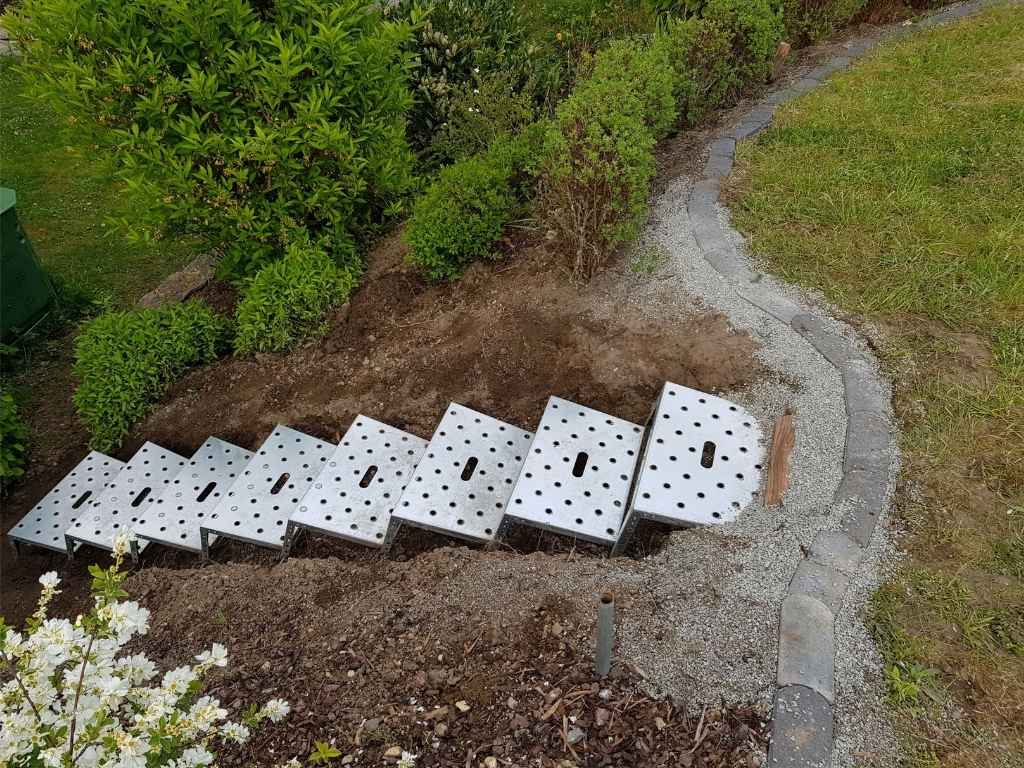
If you decide to build slope steps yourself using our products, careful installation is essential. Although assembly itself is very straightforward, the steps, stepping plates or railings should provide the desired level of safety over the long term.
Proper ground preparation is the most important step. To ensure the stepping plates are anchored as securely as possible, the ground should be well compacted. To reduce the amount of work involved, it’s a good idea to mark out the areas where you want to build slope steps yourself beforehand. That way, you only need to compact the areas where the steps or stepping plates will ultimately be installed.
Drainage plays a key role in keeping your slope steps stable over the long term. After all, the main aim is to improve footing, especially in difficult weather conditions. Allowing for a slight incline in the slope steps ensures rainwater drains away freely. Once the garden steps are complete, maintenance is minimal. To remove dirt, a little water and a soft sponge or cloth are usually all you need.
Posted in:
All posts
Related posts
 Now there is also a railing to the slope steps and to the stairs on the slope.
The poles are mounted individually and can be adjusted to the slope.
Read more
 Especially in autumn, when it gets slippery, the slope steps are a great help!
With slope steps you stand safely on the slope even in autumn.
Read more
 Slope steps are now also available powder-coated!
Slope steps are now also available in coloured versions.
Read more