 Deutsch
 English GB
 Italiano



Search in blog
Narrow garden steps on a slope
Narrow garden steps on a slope: make good use of the available space
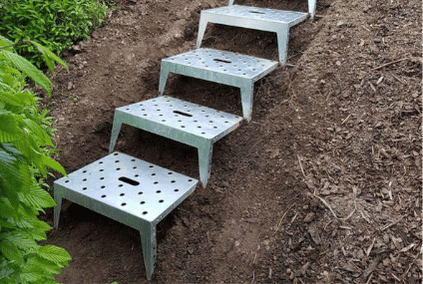
There is often little room for a path between a garden fence and a flower bed, beside a patio or along a property boundary. If there is also a change in level, planning becomes more challenging. Narrow garden steps on a slope can connect different areas of the garden. The key is to choose steps that suit the installation site and how they will be used.
If you want to choose slope steps, you should therefore consider the overall space required. In addition to the tread area, take account of the external dimensions, anchoring and sufficient room to move. Careful preparation will help you identify at an early stage which design is suitable for your garden.

Plan the route of the garden steps
First, consider which areas the path should connect. Do you want to reach a raised flower bed, get to the garden shed or add to an existing route? The planned route should suit these paths.
Next, check for any potential bottlenecks. A fence post, corner of a wall or fixed bed edging can limit the available space. So take measurements at several points along the planned ascent. Also allow for the entrance and the transition at the top.
A simple sketch will help you get an overview of the situation. Mark fixed obstacles and the distances between them. This lets you compare different layouts before deciding on a step size.
Distinguish between the tread area and the external dimensions of slope steps
Precise measurements are important for narrow garden steps on a slope. The tread measurement shown in the product selection does not automatically indicate the greatest width of the entire step.
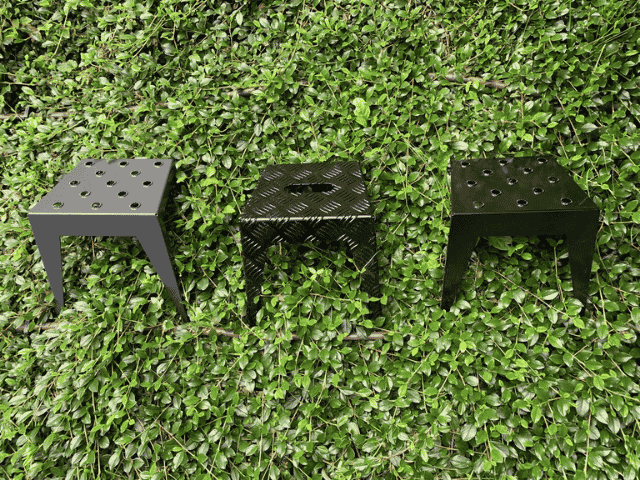
For example, in the MIDI range, the version with a selected tread measurement of 250 × 365 millimetres has a maximum external width of 445 millimetres. A gap of 40 centimetres between fixed boundaries would therefore be too narrow for this step. You can find the full measurements in our technical specifications for slope steps.
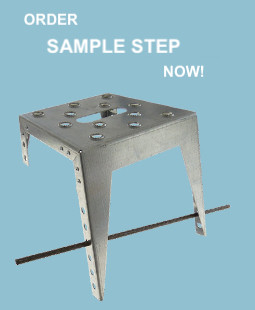
So compare the dimensioned drawing for your chosen version with your sketch. Also allow space for the anchoring. The crosswise steel bar may extend beyond the external width of the step and will also need room at the installation site.
Allow room to move while gardening
The right garden steps should also provide a passageway that is easy to use in everyday life. Think about typical situations: you are carrying a watering can, taking a tool bag with you or bringing a collection container to the flower bed.
So, as well as the space at ground level, check the surroundings at body height. Overhanging branches, spreading shrubs or protruding structures can restrict your freedom of movement.
Include the return journey in your considerations. A route that seems clear when going up may present different challenges when going down. If a section seems too narrow, it is worth considering a slightly offset route.
Choose the right tread area
A small step takes up less space, but still needs to suit how you will use it. So assess the tread area with the footwear you wear for gardening in mind.
For an initial size comparison, you can trace the outline from the dimensioned drawing onto paper and view it on a flat, dry surface. This makes it easier to judge the dimensions than looking at a figure in the online shop. However, you will still need to assess the ground, slope and suitability of the installation.
Think ahead to next summer in autumn
November is a good time to prepare your garden design for the coming season. With deciduous plants, a path often looks more spacious after the leaves have fallen. So consider how far leaves and branches will extend into the passageway during the growing season.
Photos taken in summer can help. Also plan to keep the steps accessible for inspection and cleaning.
For installation and use, follow our safety instructions for slope steps. These include secure anchoring and checking stability. Do not use the steps in rain, wet conditions, ice or snow. After such weather, check the ground and anchoring before using them again.
Find suitable slope steps for your garden
The measurements of the narrowest point, information about the slope and photos of the planned route are particularly helpful when choosing. Also note any fixed boundaries and how you intend to use the path.
Are you planning narrow garden steps on a slope and want to find the right design? Get advice from us about slope steps. Together, we can work out which options suit the space available in your garden.
Posted in:
All posts
Related posts
 Now there is also a railing to the slope steps and to the stairs on the slope.
The poles are mounted individually and can be adjusted to the slope.
Read more
 Especially in autumn, when it gets slippery, the slope steps are a great help!
With slope steps you stand safely on the slope even in autumn.
Read more
 Slope steps are now also available powder-coated!
Slope steps are now also available in coloured versions.
Read more